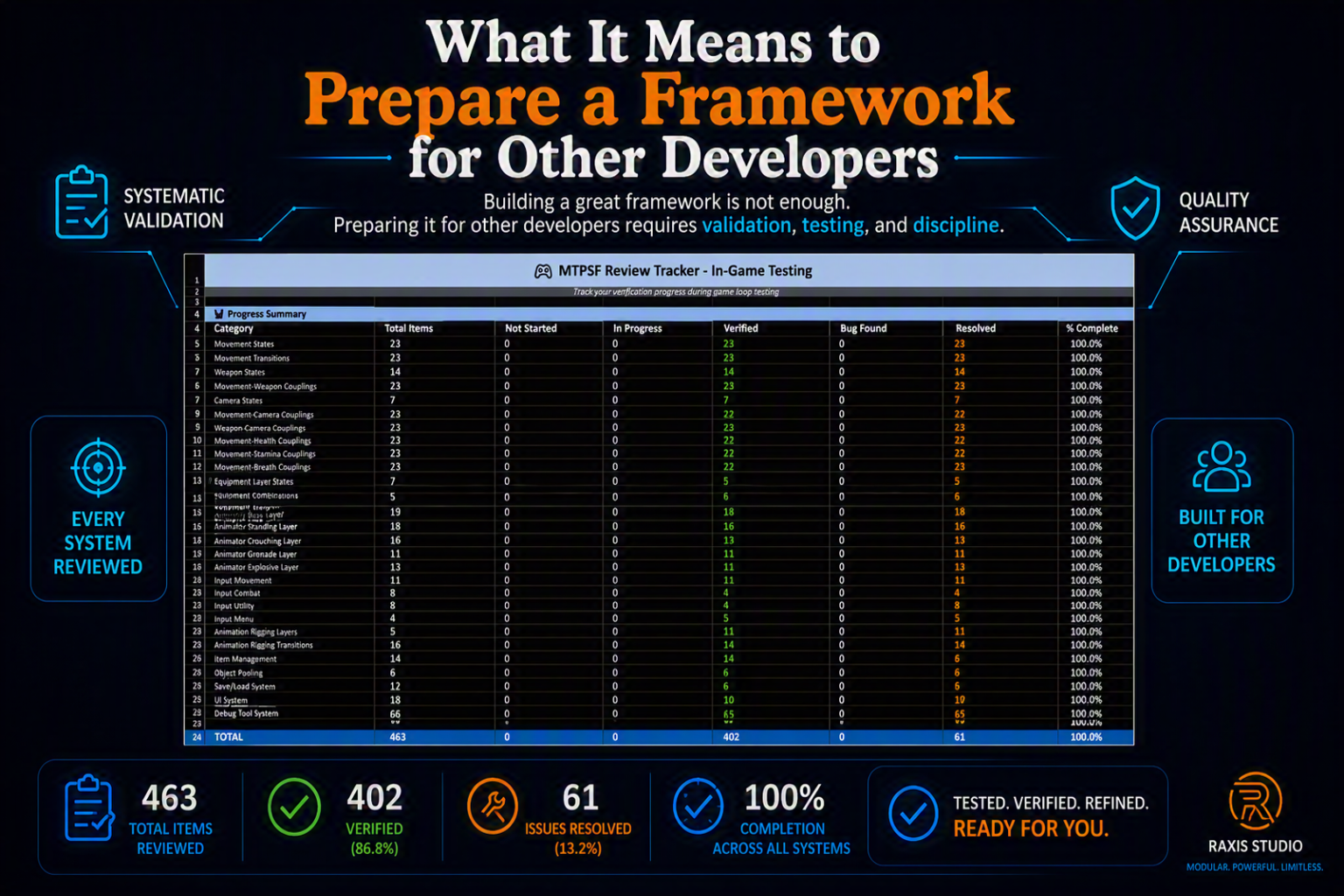
What It Means to Prepare a Framework for Other Developers
Preparing a framework for other developers means thinking beyond whether the systems work in the original project. A reusable Unity asset needs to be understandable, consistent, documented, and reliable when it is imported into a different environment.
This requires a different level of preparation than building a system only for internal use. In a modular shooter framework, many systems must cooperate. Movement, weapons, camera behavior, interaction, inventory, health, UI feedback, configuration assets, events, and state machines all need to work together.
When a framework is prepared for other developers, each of these systems should be reviewed not only for functionality, but also for clarity, consistency, and usability. One part of preparation is validation. A system may appear to work during regular development, but validation asks a more careful question: does the system behave correctly across expected scenarios? For a shooter framework, this can include checking weapon behavior, movement transitions, interaction states, configuration changes, UI responses, and edge cases that may appear when systems overlap.
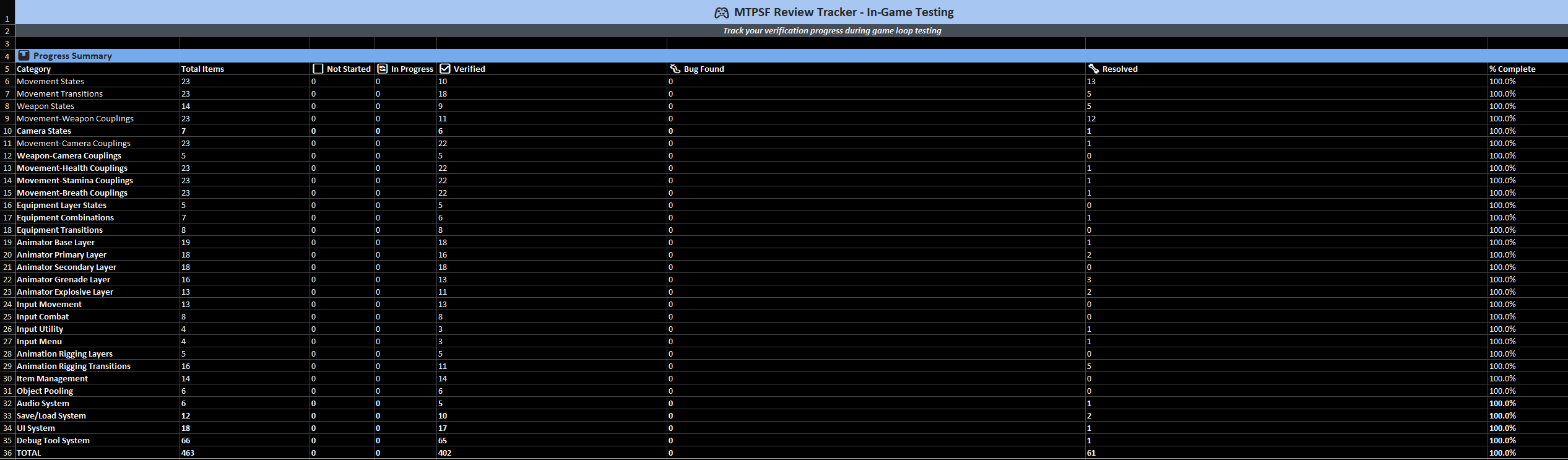
Review passes are also important. A review pass gives the framework a chance to be inspected from different angles. One pass may focus on bugs. Another may focus on naming. Another may focus on configuration consistency, documentation, inspector organization, or project structure.
This helps reduce the chance that small issues remain hidden until another developer begins using the asset. Bug tracking supports this process by turning observations into organized work. Instead of relying on memory, issues can be recorded, categorized, reviewed, and resolved systematically.
This is especially useful in a framework where one issue may involve several systems. A recorded issue can help identify whether the problem belongs to gameplay logic, configuration, communication, UI feedback, or documentation. Naming cleanup is another part of product readiness. Names affect how quickly another developer can understand the project. A class name, method name, ScriptableObject name, folder name, or event name can either clarify intent or create confusion. Clean naming helps the framework feel more deliberate and easier to navigate.
Consistency checks are also necessary because reusable frameworks are judged by more than isolated features. Folder organization, inspector fields, configuration assets, tooltips, XML summaries, documentation style, and setup flow should feel connected. When these details are consistent, the framework becomes easier to trust because developers can see a clear pattern across the product. Documentation is part of this preparation as well.
A system that works but is not explained can still be difficult to use. Developers need to know how to set up the framework, where configuration values are stored, how major systems communicate, and which parts are intended for extension. Documentation helps turn the codebase into a usable product. Preparing a framework for other developers also means reducing unnecessary assumptions.
A system built for one scene or one setup may rely on hidden conditions that are not obvious to someone else. Product-readiness work helps identify those assumptions and make the framework more understandable, configurable, or documented before release.
MTPSF is being prepared with this type of product-readiness mindset. The goal is not only to create shooter systems that function, but to make those systems easier to inspect, configure, validate, and understand.
This kind of preparation supports developers who may import the framework into their own projects and need to evaluate how it fits their workflow. This preparation matters because a reusable framework is experienced differently from an internal tool. Internal tools can rely on the knowledge of the person who built them.
A released asset needs to communicate that knowledge through structure, naming, documentation, and predictable behavior. The framework should guide developers instead of forcing them to reverse-engineer every decision.
Preparing a framework for other developers is therefore a combination of technical cleanup and product thinking. It includes review passes, bug tracking, validation, naming cleanup, consistency checks, documentation, and careful organization.
For MTPSF, these steps help move the framework from a working development project toward a product that developers can understand, trust, and build upon.