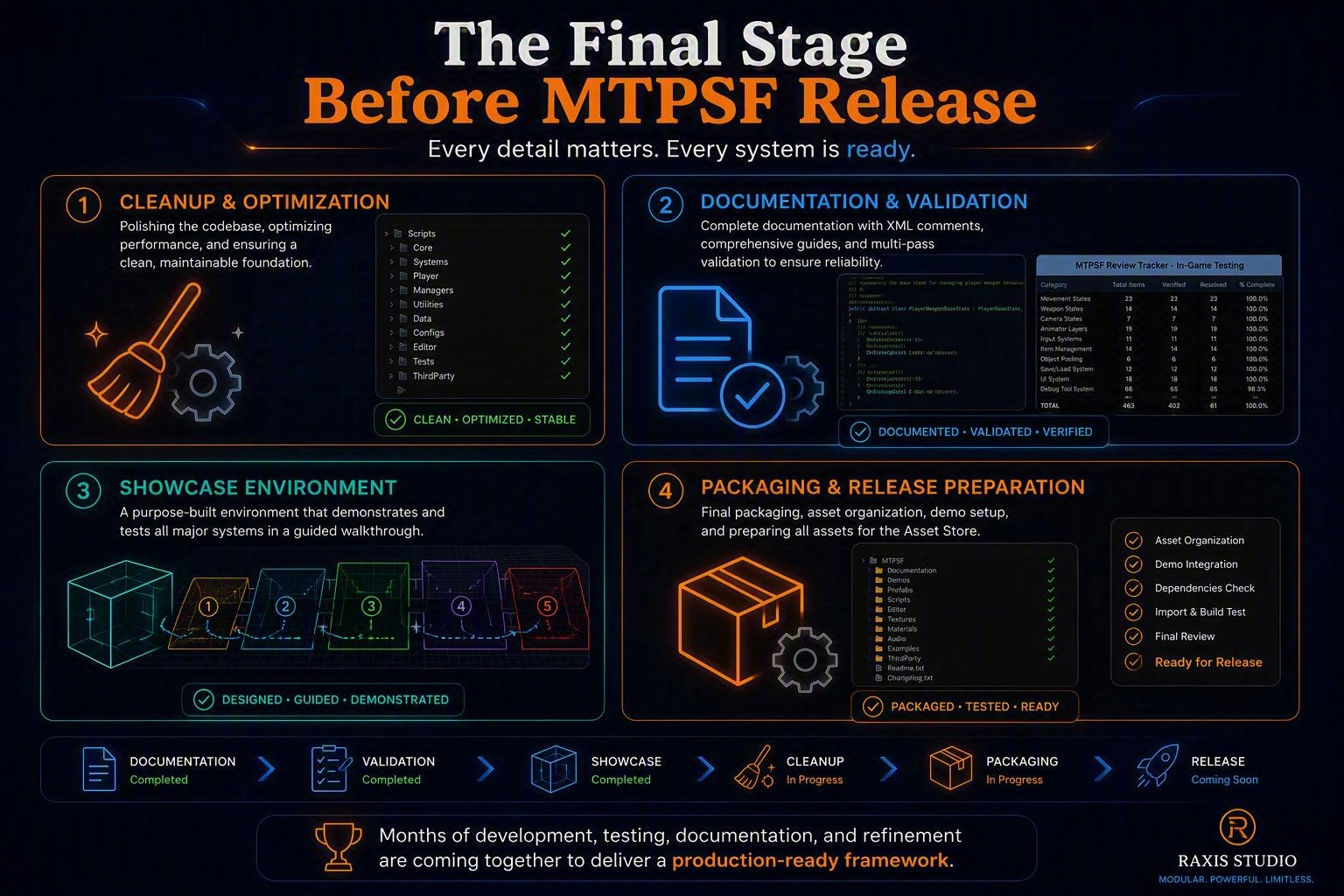
The Final Stage Before MTPSF Release
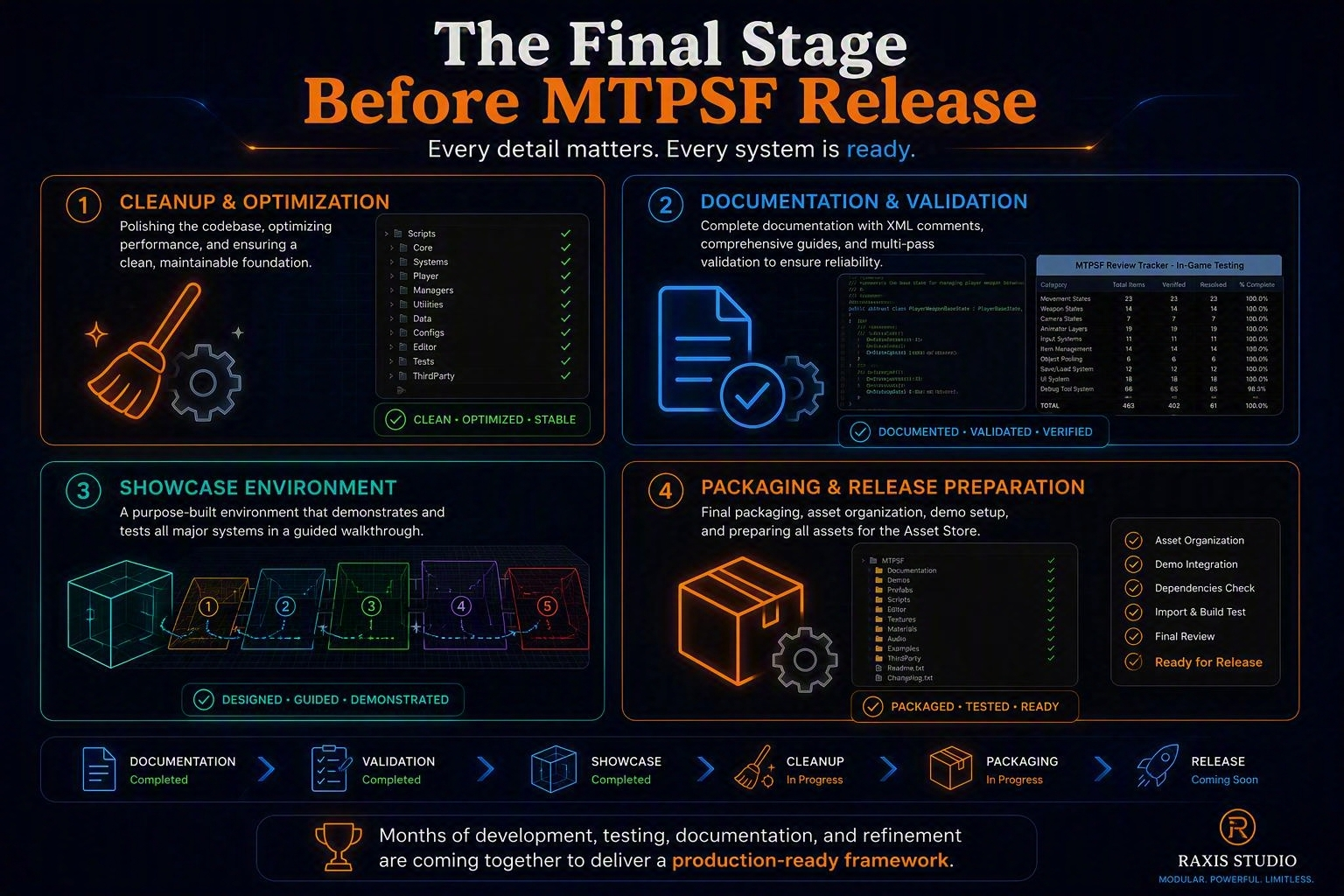
The final stage before releasing a Unity framework is not only about finishing the last feature. It is about making sure the product is ready to be reviewed, understood, imported, tested, and used by other developers.
For a modular shooter framework like MTPSF, this stage includes technical cleanup, documentation, validation, showcase preparation, and package organization. A framework can reach a point where the core systems are working, but that does not automatically mean it is ready for release. Systems need to be checked for consistency. Configuration assets need to be organized. Documentation needs to explain setup and usage. Showcase content needs to demonstrate the framework clearly. The final stage is where the product moves from development completion toward release readiness. Code cleanup is one part of this process.
The goal is not to rewrite working systems unnecessarily, but to make sure the codebase is clean enough for developers to inspect and understand. Naming, structure, XML summaries, folder organization, inspector fields, and unnecessary leftovers all affect how professional the framework feels after import. Documentation is another major part of the final stage. A reusable Unity asset should provide more than working scripts.
Developers need guidance on how to set up the framework, where configuration data is stored, how major systems are organized, and what parts are intended to be extended or customized. Clear documentation helps reduce uncertainty and makes the framework easier to evaluate. Validation is also important because a shooter framework includes many connected systems. Movement, weapons, camera behavior, interaction, inventory, health, UI feedback, events, state machines, and configuration assets may all interact during gameplay.
Before release, these systems need to be tested not only individually, but also in the situations where they overlap. This is where review passes become useful. A review pass can focus on functionality, another on documentation, another on naming, another on configuration, and another on final user experience.
This structured approach helps catch issues that may not appear during regular development. It also supports a more deliberate release process instead of relying only on last-minute checks.
Showcase preparation is part of release readiness as well. A framework needs a clear way to present what it does. The showcase environment, demonstration videos, screenshots, and product visuals should help developers understand the systems without making the presentation confusing or overloaded.
The goal is not only to show that features exist, but to show them in a way that communicates their purpose. Package organization is another important detail.
A Unity Asset Store package should be prepared so developers can understand what is included, where files are located, and how the asset is structured. Clear folders, clean prefabs, organized ScriptableObjects, documentation files, and example scenes all contribute to the first impression after import. Release readiness also means reducing unnecessary dependencies and assumptions.
A framework should not rely on hidden setup choices that are unclear to the developer. If something needs to be configured, it should be documented. If a system has expected dependencies, they should be visible. If a scene demonstrates a feature, the feature should be understandable without requiring the developer to guess what is happening behind the scenes.
For MTPSF, the final stage is connected to the same modular philosophy behind the framework itself. The product is not only being prepared to demonstrate shooter gameplay, but also to make that gameplay understandable through structure, configuration, documentation, and presentation.
This preparation supports developers who may want to evaluate the framework seriously before using it in their own projects. This stage can also help reveal whether the framework is ready from the developer’s point of view. If documentation is incomplete, if configuration is unclear, if naming is inconsistent, or if the showcase does not explain the systems well, those issues can affect adoption even when the core mechanics work. Product readiness requires looking at the framework as a complete developer experience.
The final stage before MTPSF release is therefore about refinement, not only completion. It brings together code cleanup, documentation, validation, showcase content, and package organization so the framework can be presented with clarity and confidence. A modular shooter framework needs to work, but it also needs to be prepared in a way that helps developers understand, trust, and build upon it.