Why Shooter Frameworks Become Difficult to Maintain
Shooter frameworks can become difficult to maintain because they rarely stay small for long.
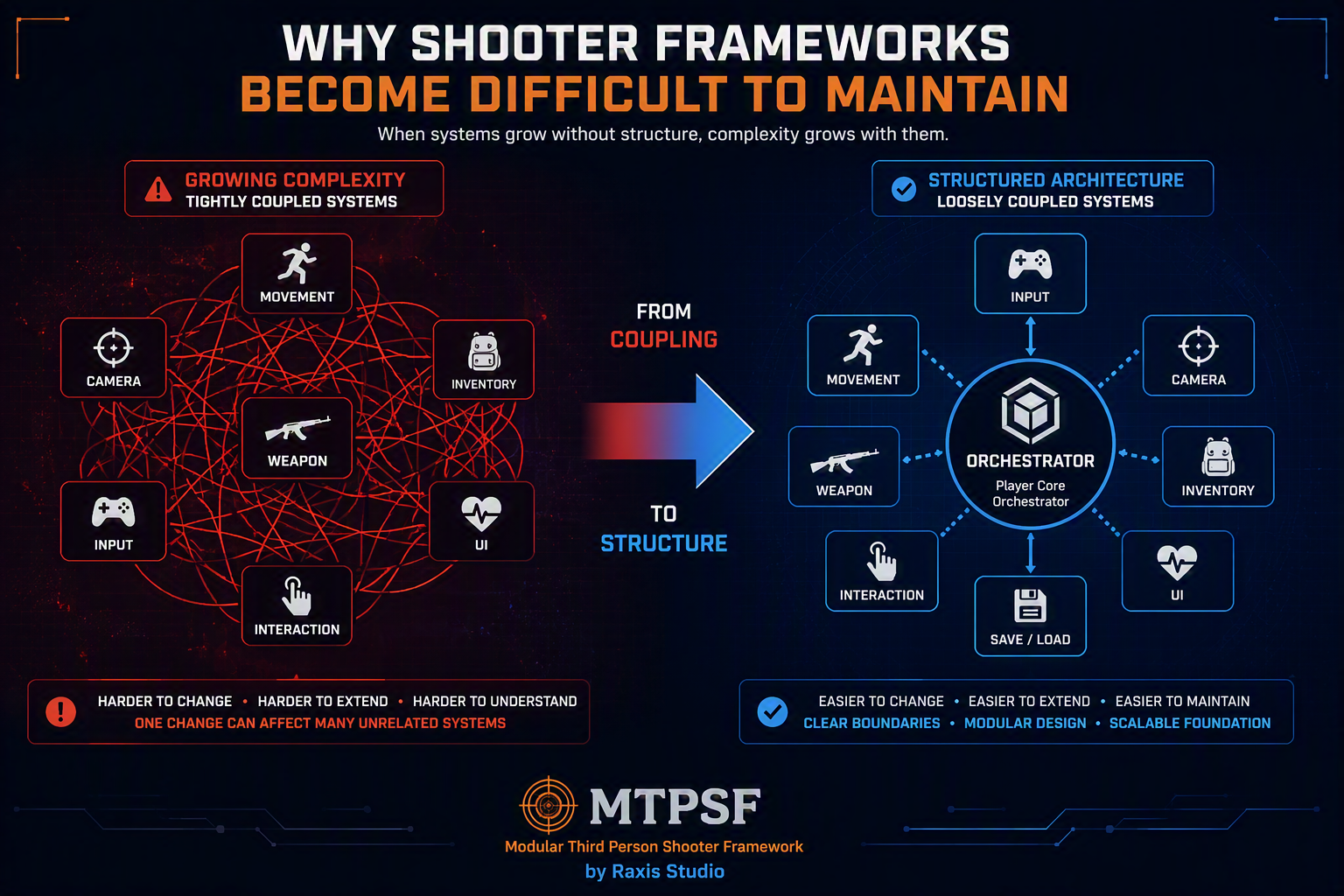
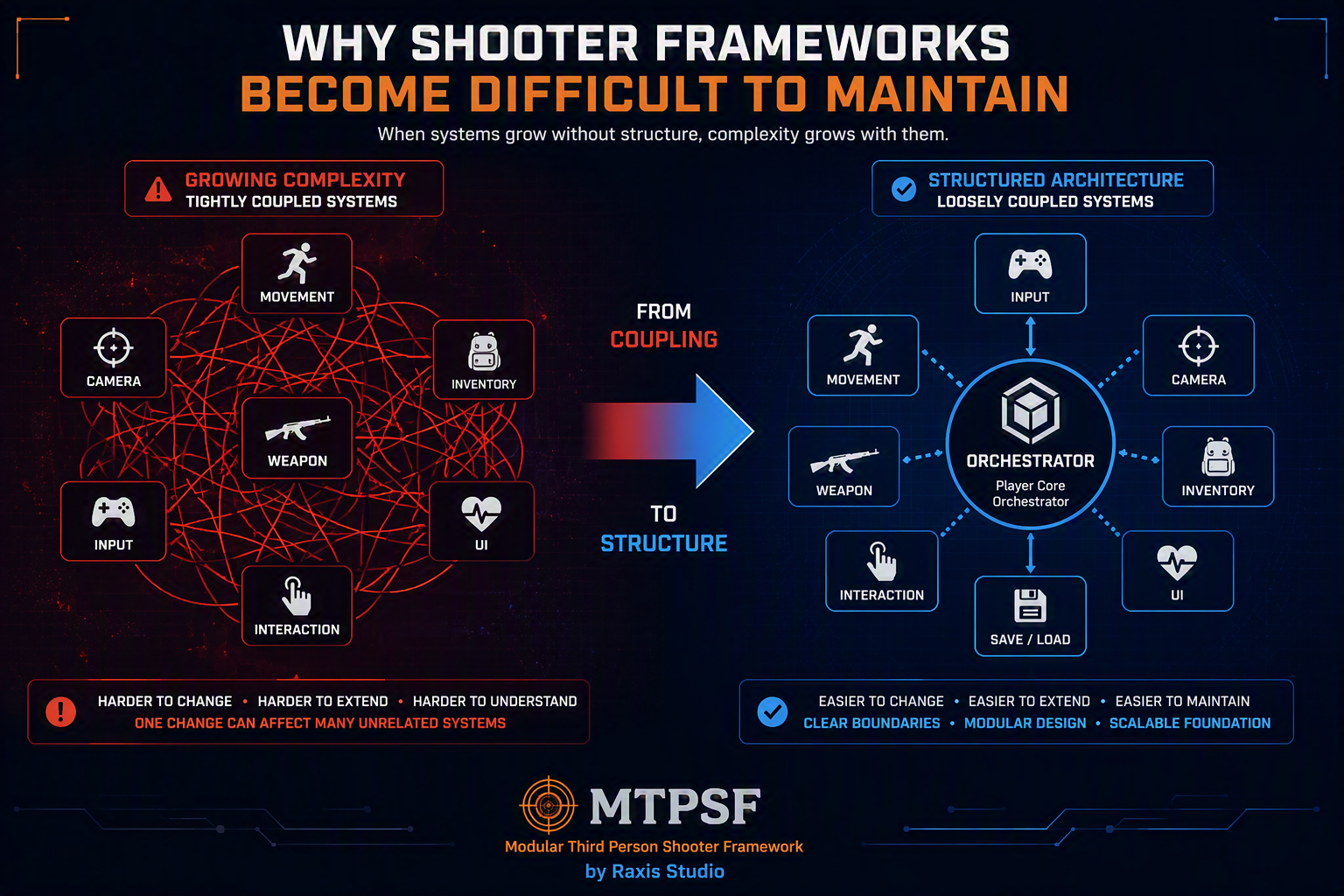
What may begin as a simple player controller with aiming and shooting can quickly grow into a network of connected systems. Movement, camera behavior, weapon handling, input, interaction, inventory, health, user interface feedback, surface response, and gameplay states all need to work together.
The challenge is not only building these systems, but keeping them organized as the framework grows.
In the early stages of development, tight connections between systems may feel practical. A weapon script can directly ask the camera to change its behavior. A movement script can directly check whether the player is aiming. A UI script can read values from different gameplay components. These direct connections may solve the immediate problem, but they also create hidden dependencies that become harder to manage when the project expands.
The problem appears when a new feature needs to be added or an existing behavior needs to change. If aiming affects camera position, movement speed, weapon accuracy, animation state, input handling, and UI feedback, then one change can require updates across several unrelated scripts. This makes the system fragile. A developer may fix one behavior and accidentally affect another because the boundaries between systems are not clear. This is especially common in shooter systems because many mechanics are active at the same time. The player can move while aiming, aim while switching weapons, reload while receiving UI feedback, interact with an object while the camera changes, or enter a combat state that affects several systems at once. When every system tries to control or inspect every other system directly, the codebase becomes harder to understand.
Maintainability depends on more than whether the framework works during testing.
A system can appear functional in a controlled scene but still be difficult to extend if its internal structure is unclear. If weapon behavior, player state, interaction rules, camera logic, and UI updates are mixed together, the framework may become harder to adapt for different projects, different weapons, or different gameplay styles.
This is why separation of responsibilities matters. Each system should have a clear purpose. Movement should handle movement decisions. Weapon systems should focus on weapon behavior. Camera systems should manage camera response. UI should present information without becoming responsible for gameplay decisions.
When each part has a defined role, the project becomes easier to inspect, debug, and improve. Another reason shooter frameworks become difficult to maintain is configuration. If values are hardcoded inside multiple scripts, balancing or adjusting behavior becomes time-consuming. Weapon settings, movement values, camera response, interaction distances, and other tunable data should be organized in a way that supports iteration.
A framework becomes easier to work with when important settings can be adjusted without searching through unrelated logic. Communication between systems is also important. A maintainable framework does not require every system to know the full details of every other system. Instead, systems should communicate through clear boundaries, events, contracts, or controlled access points.
This helps reduce coupling and makes the framework easier to reason about. When a system reacts to a meaningful event instead of constantly checking another system’s internal state, the relationship between those systems becomes cleaner. For reusable Unity assets, this becomes even more important.
A framework is not only used by the person or team that created it. It may be imported into different projects, studied by different developers, and adapted to different production needs.
If the structure is difficult to follow, developers may hesitate to extend it even if the visible features look useful. Maintainability becomes part of the product experience.
MTPSF is being shaped with this challenge in mind. Shooter systems need to feel connected during gameplay, but they should not become unnecessarily tangled behind the scenes.
A modular approach helps keep the framework organized by giving each system a clearer role and reducing the risk that one change will unexpectedly affect many others.
The difficulty of maintaining shooter frameworks usually comes from growth without structure. As features increase, the need for clear responsibilities, clean communication, configurable data, and predictable behavior becomes stronger.
A shooter framework that is built with these concerns in mind is easier to understand, easier to extend, and more practical for long-term development.