Why MTPSF Was Built as More Than a Shooter Controller
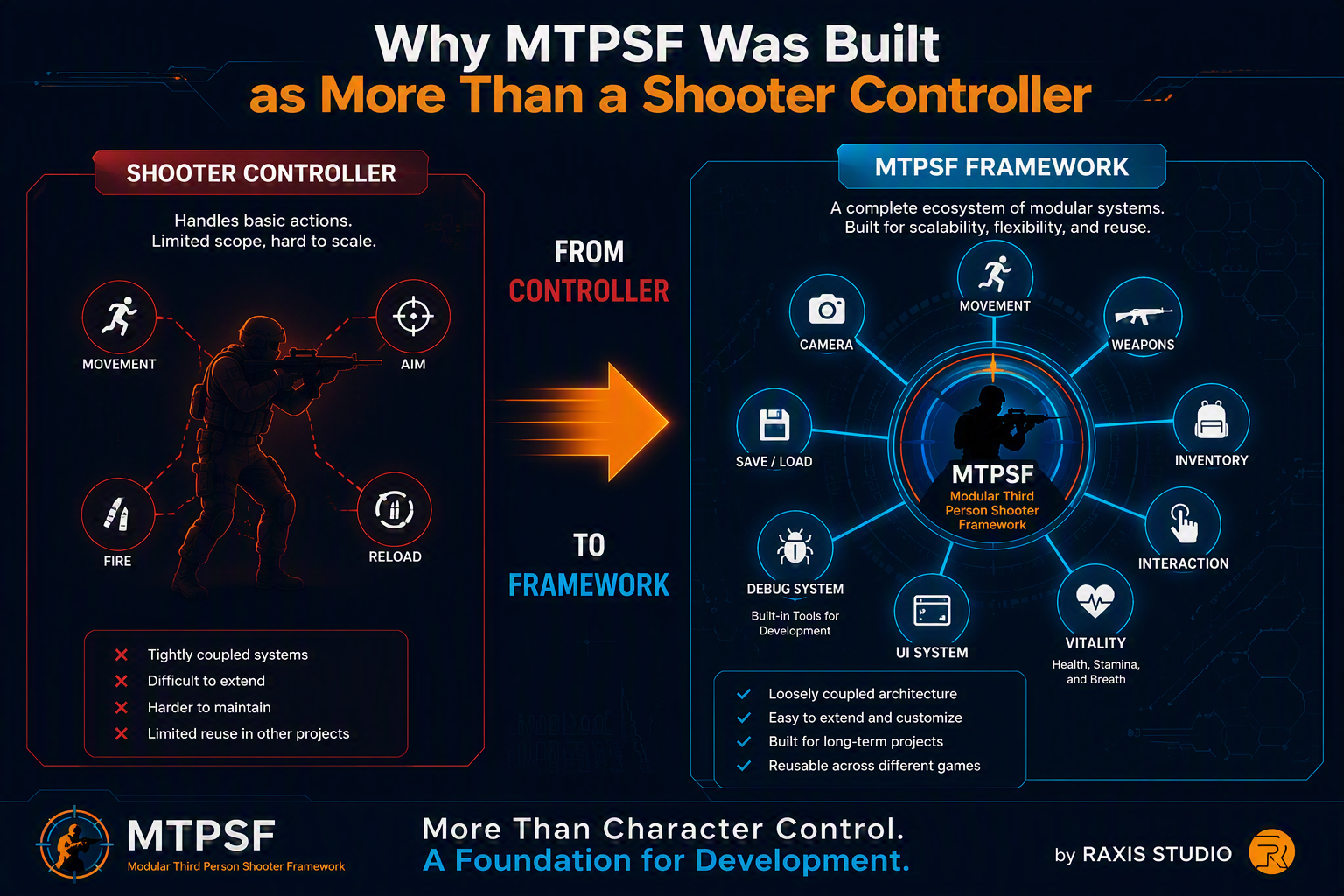
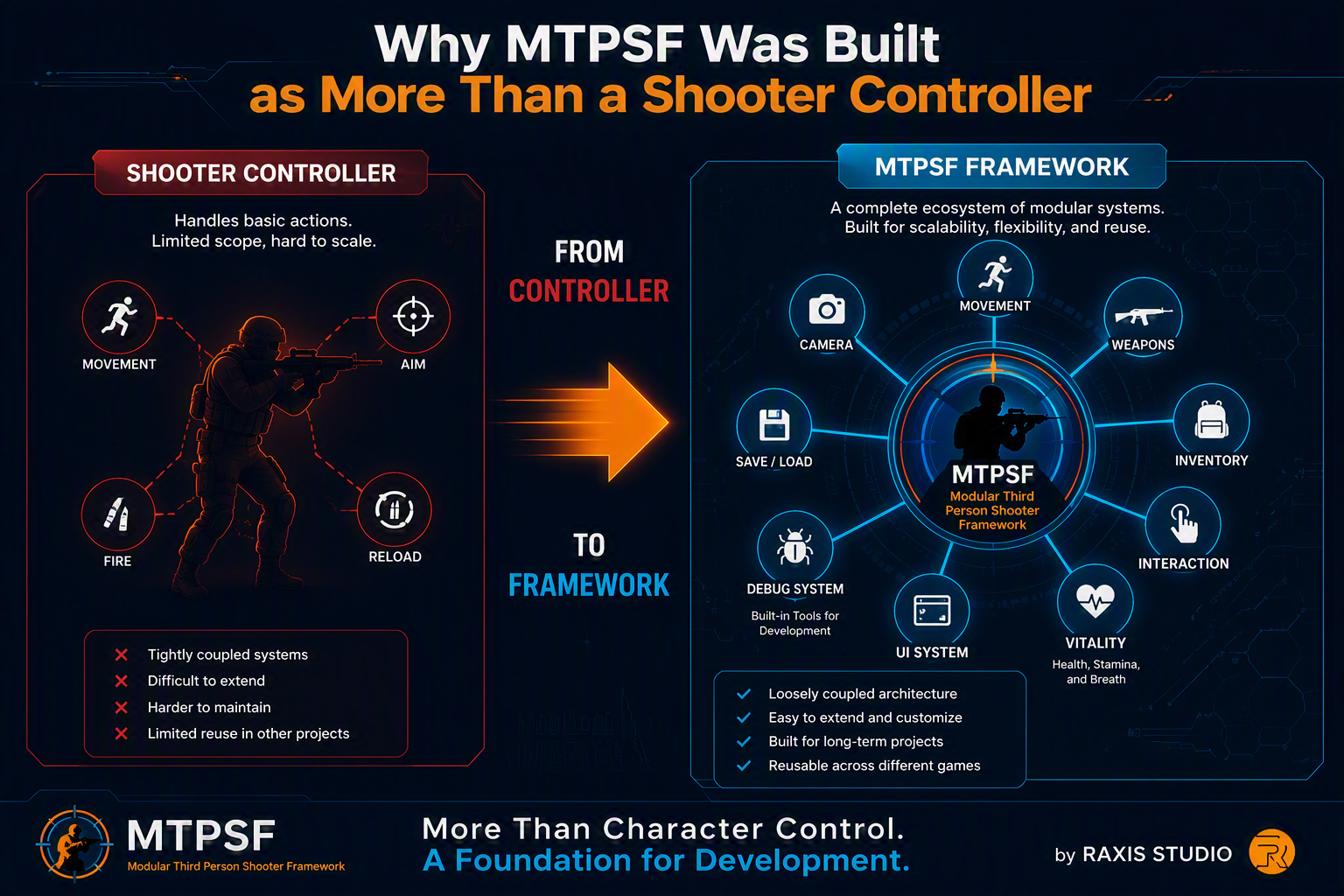
A shooter controller is often one of the first systems developers think about when building a third person shooter. It controls how the character moves, aims, fires, reloads, and responds to input.
For small prototypes, this may be enough. A single controller can bring the basic gameplay loop to life and make the project feel playable quickly. However, a complete shooter project usually needs more than a controller.
As the project grows, the controller becomes only one part of a larger gameplay foundation. Weapon behavior, camera response, player states, inventory logic, interactions, health systems, surface feedback, UI updates, and configuration data all need to work together. If everything is placed inside one controller or built too closely around it, the system can become difficult to extend.
This is one of the reasons MTPSF is being developed as more than a shooter controller. The goal is not only to make a character shoot, aim, or switch weapons.
The goal is to provide a structured framework where related systems have their own responsibilities and can cooperate without becoming hidden inside one large script or one tightly connected object.
In many shooter systems, the controller gradually becomes responsible for too much. It may start by handling movement and input, then later manage aiming, weapons, camera states, inventory checks, interaction rules, animation decisions, UI feedback, and gameplay conditions. This can work for a while, but it creates a central point where too many decisions are mixed together. Over time, this makes the project harder to read, harder to test, and harder to modify.
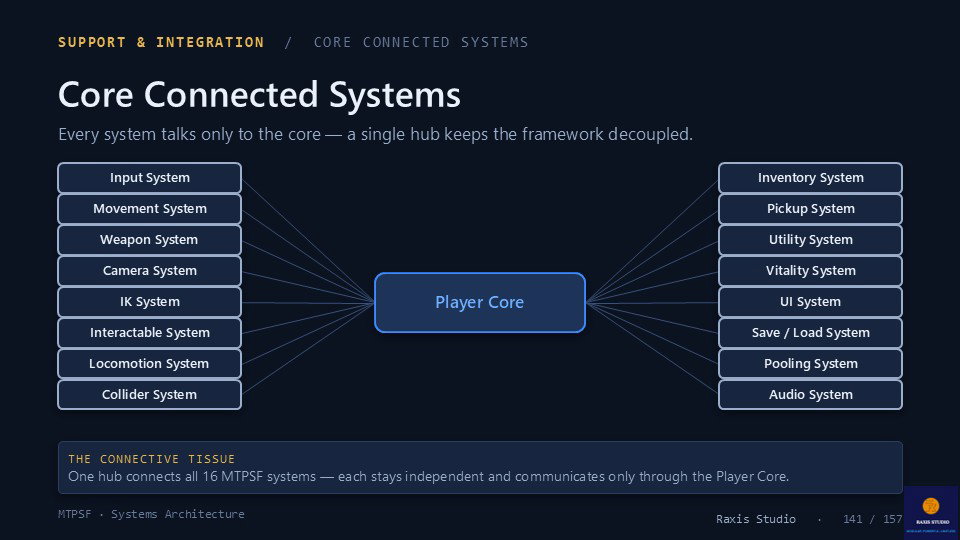
A framework takes a different approach. Instead of treating the controller as the place where everything belongs, a framework separates the project into connected systems. Each system has a clearer purpose. The weapon system focuses on weapon behavior. The movement system focuses on player movement. The camera system responds to gameplay context. Inventory and interaction systems manage their own responsibilities. UI systems present information instead of controlling gameplay logic. This separation does not mean the systems are isolated from each other. Shooter gameplay still requires coordination. Aiming may influence camera behavior. Weapon state may affect movement or UI feedback. Interaction states may change what the player can do.
The important difference is how these systems communicate. A framework should allow systems to work together through clear boundaries instead of forcing every part to depend directly on every other part. This also affects how developers use the asset. A controller may help produce gameplay quickly, but a framework should help developers understand the structure behind the gameplay. It should make it easier to identify where behavior belongs, where values are configured, and how systems respond to each other.
This becomes important when the asset is imported into a different project and needs to support different requirements.
MTPSF is being shaped with this broader purpose in mind. It is not only about providing visible shooter mechanics. It is also about creating a foundation that supports modular development, cleaner responsibilities, and a more understandable workflow.
This makes the framework more practical for developers who need more than a single ready-made controller. Another important difference is long-term adaptability.
A shooter controller may be designed around one expected gameplay style.
A framework, by contrast, should make it easier to adjust, replace, extend, or configure parts of the system without rewriting everything from the beginning.
This is especially important for Unity developers who may have different character setups, camera preferences, weapon types, interaction needs, or project-specific design goals.
By positioning MTPSF as a framework, the focus shifts from one central controller to a collection of systems that work together. This gives the product a clearer development direction: not only to make shooter gameplay possible, but to make that gameplay easier to understand, configure, maintain, and build upon.
MTPSF is still moving toward release, but its purpose is already defined by this distinction. It is not being built as only a shooter controller that handles actions on screen. It is being built as a modular shooter framework where the structure behind those actions matters. That structure is what can make the framework more useful for real development, especially when projects grow beyond the first playable prototype.