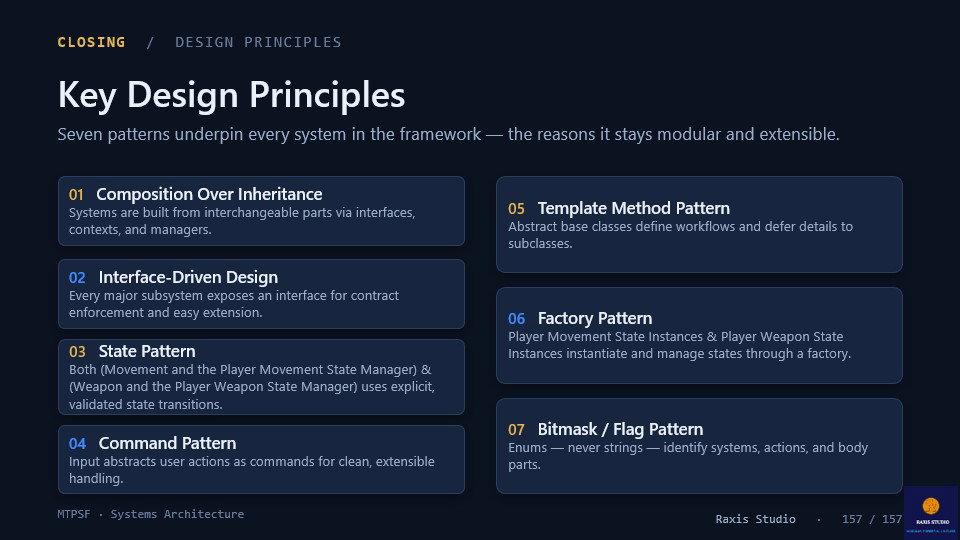
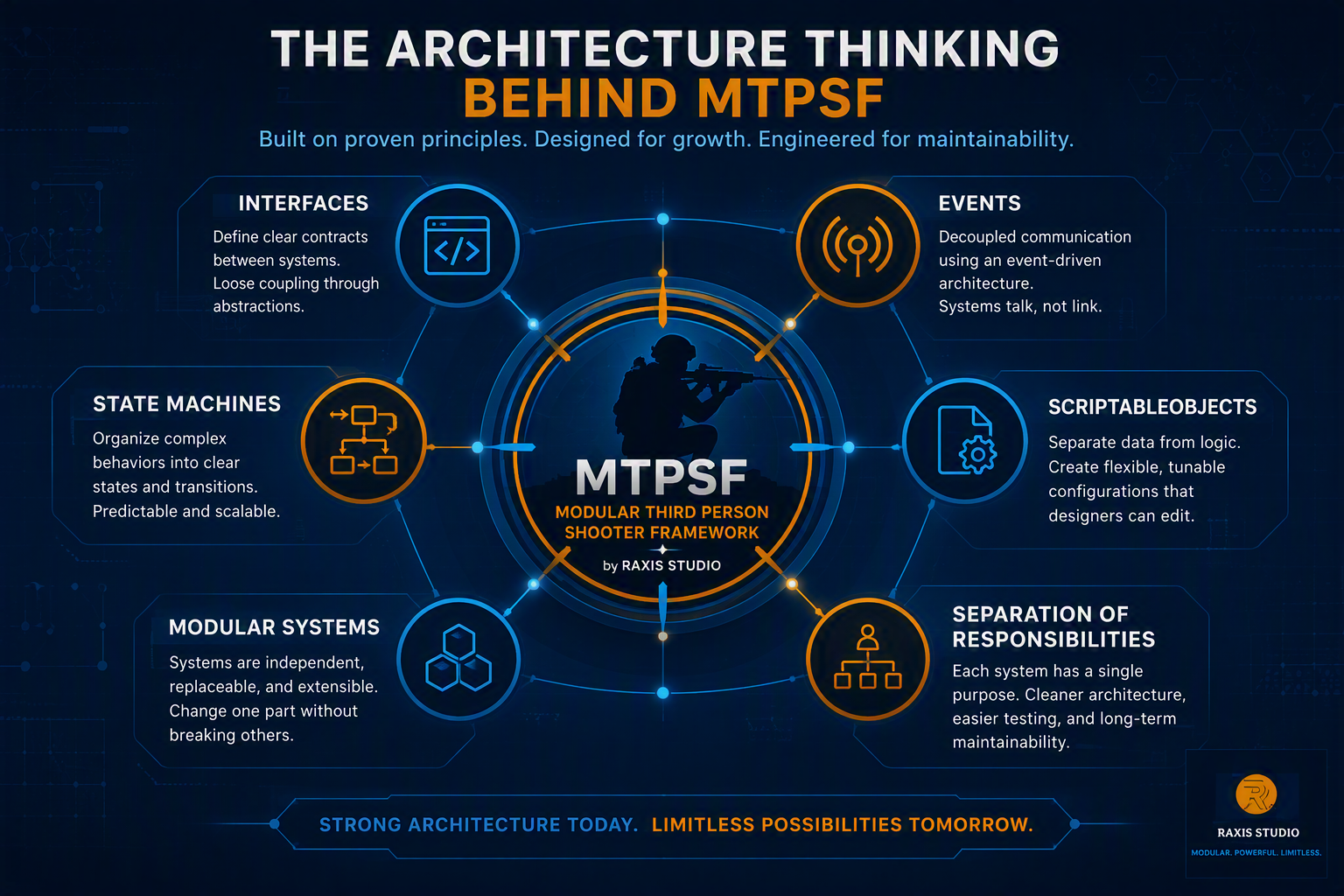
The Architecture Thinking Behind MTPSF
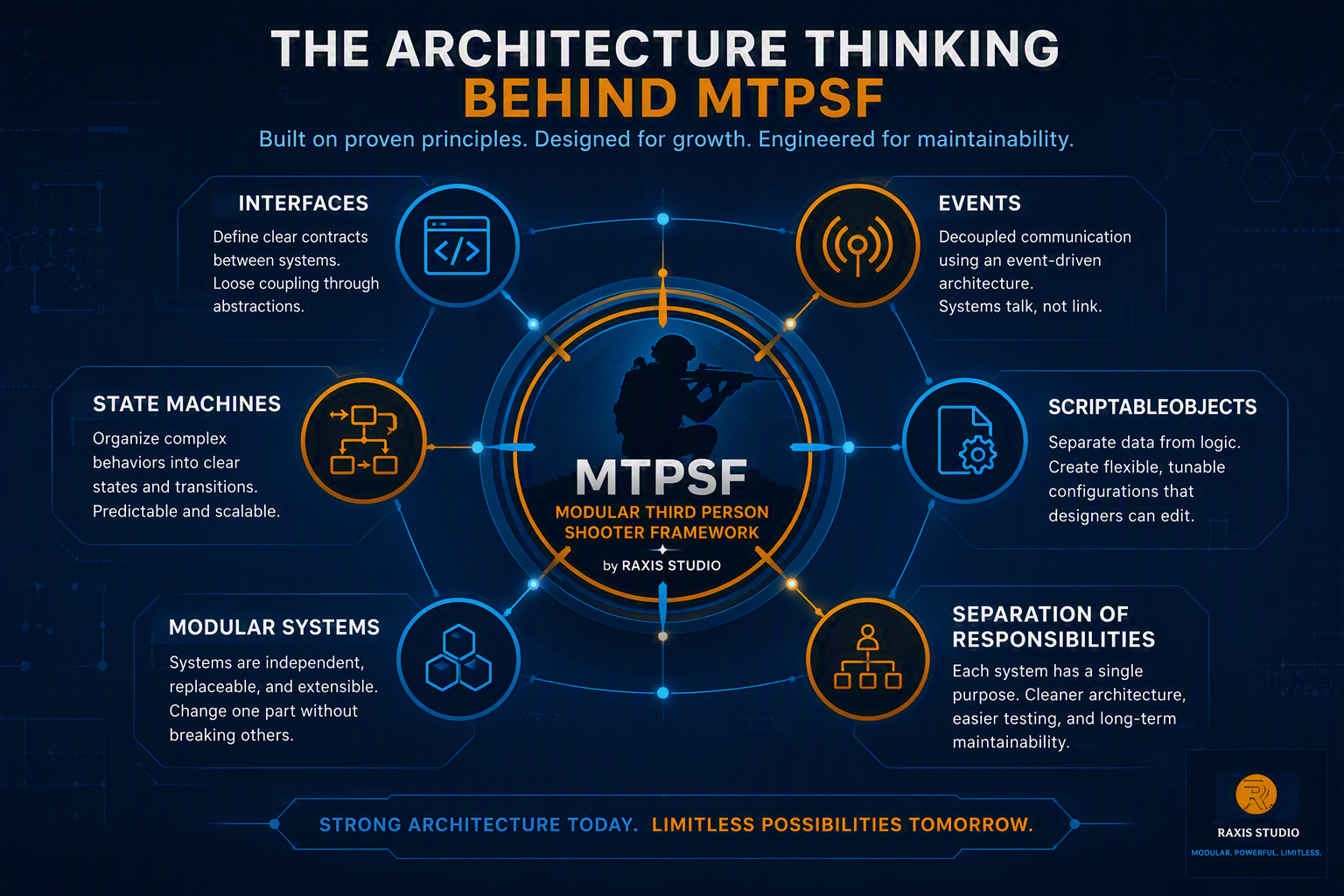
Architecture becomes important in a shooter framework because the visible gameplay is only one part of the product. A player may see movement, aiming, shooting, weapon switching, interaction, and UI feedback, but behind those actions there are many systems that must communicate clearly.
If the architecture is weak, the framework may still work in a controlled demonstration, but it can become difficult to understand, extend, or maintain when development continues.
MTPSF is being shaped around the idea that shooter systems should be connected through structure rather than forced together through direct dependencies. This means each system should have a defined role, a clear boundary, and a practical way to communicate with other systems.
The goal is not to make the framework complicated, but to make its complexity easier to manage. One of the core ideas behind this direction is separation of responsibilities.
In a shooter framework, it can be tempting to let one central object handle too many decisions. A player controller may begin by handling movement, but later it may also check weapon state, control camera behavior, manage input conditions, update UI feedback, and respond to interaction logic. When too many responsibilities are placed in one area, the system becomes harder to inspect and easier to break.
A cleaner architecture gives each system a more focused purpose. Movement logic should remain focused on movement behavior. Weapon logic should remain focused on weapon behavior. Camera logic should respond to gameplay context without owning unrelated systems. UI should reflect information without becoming responsible for gameplay decisions. This kind of structure helps keep the framework readable as more systems are added. Interfaces are useful in this kind of architecture because they allow systems to communicate through contracts instead of depending directly on concrete classes.
A system does not always need to know the exact implementation behind another system. It often only needs to know what behavior is available. This helps reduce coupling and makes it easier to replace, extend, or adjust parts of the framework without rewriting large sections of code.
Events also play an important role in reducing unnecessary connections. In a shooter framework, many systems need to respond to changes: a weapon is equipped, ammunition changes, the player enters an aiming state, health is reduced, or an interaction becomes available.
Event-driven communication allows systems to react to meaningful changes without constantly checking or controlling each other directly.
State machines are another important part of the architecture thinking. Shooter behavior often depends on current conditions.
A player may be idle, moving, aiming, reloading, interacting, or using cover. A weapon may be equipped, firing, reloading, empty, or unavailable. When these conditions are handled as clear states, behavior becomes easier to predict. Clear state flow helps reduce hidden logic and makes transitions easier to reason about.
Scriptable-Objects support a different but equally important part of the framework: configuration. Shooter systems often need many tunable values, such as weapon settings, movement values, camera response, recoil behavior, interaction distances, and other gameplay data. Keeping this kind of data organized outside hardcoded logic makes the framework easier to configure and easier to adjust during development.
These architectural choices work together to support modularity. Modularity does not mean systems are disconnected from each other. It means they are connected in a controlled and understandable way. A modular shooter framework still needs movement, weapons, camera, interaction, and UI to cooperate during gameplay, but those systems should cooperate through clear structure rather than uncontrolled dependencies.
This approach is especially useful for reusable Unity assets. Developers who import a framework into their own projects need more than working mechanics. They need to understand where to look, where to configure values, how systems communicate, and how changes may affect the rest of the project. Architecture becomes part of the usability of the product, not only part of its internal code quality.
The architecture thinking behind MTPSF is built around this balance. The framework needs to support connected shooter gameplay, but it also needs to remain organized enough for developers to study, modify, and build upon. Clean responsibilities, clear communication, configurable data, and predictable behavior all help move the framework in that direction. Strong architecture is not only about making a system look well designed on paper. It is about making future work safer and clearer. In a shooter framework, every new mechanic can create new connections between systems.
A structured architecture helps those connections remain manageable, which is one of the reasons MTPSF is being prepared as a modular framework rather than a collection of isolated features.