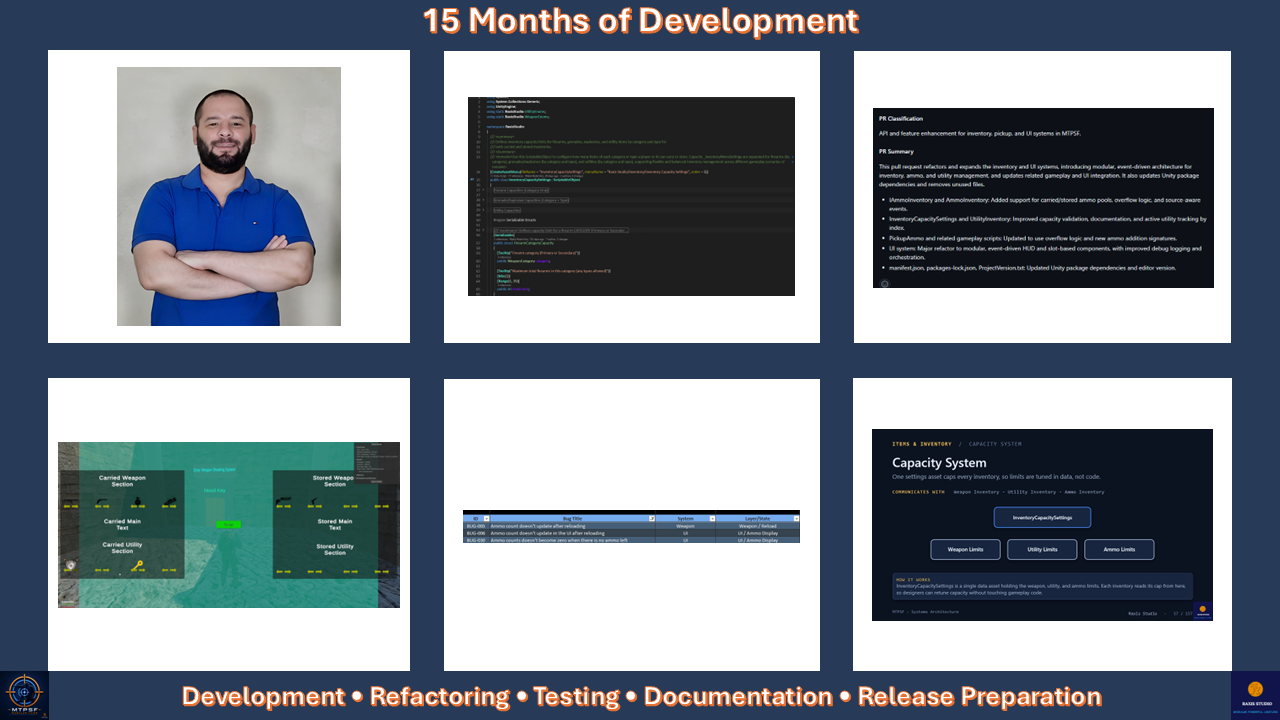
Lessons Learned During 15 Months of Building MTPSF
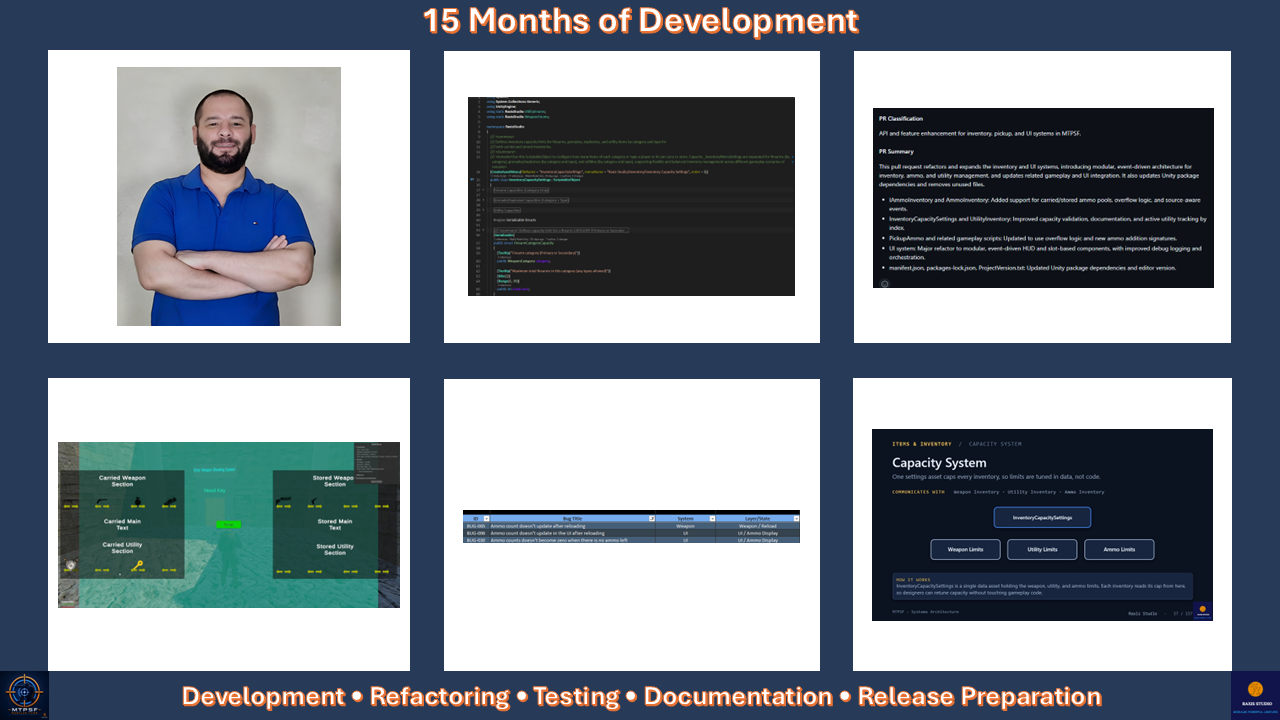
The Work Became Bigger Than the Feature List
MTPSF took more than 15 months to develop, but the most important lessons did not come from counting systems or completed features. They came from repeatedly asking whether another developer could understand, configure, trust, and extend the product. Building a commercial Unity framework changed the standard. Code that worked internally still needed clearer responsibilities, better naming, stronger documentation, safer configuration, repeatable setup, validation, and a presentation that accurately represented the product.
Lesson 1: Features Are Only Part of the Product
It is easy to measure progress through visible features. Weapons, cover, inventory, utilities, interactions, health, camera behavior, and other systems make progress tangible. However, features do not automatically create a usable framework. The complete product also includes the relationships between systems, the configuration workflow, documentation, demonstrations, package organization, support process, and the confidence developers feel when they first import the asset.
Lesson 2: Architecture Is an Ongoing Discipline
Architecture was not a single phase completed before implementation. It appeared in daily decisions about responsibility, dependencies, configuration, events, states, factories, commands, observers, interfaces, and composition. The lesson was that maintainability comes from consistent decisions. One clean diagram cannot compensate for systems that ignore boundaries during implementation. Architecture has to remain visible throughout development, review, debugging, and extension.
Lesson 3: Documentation Reveals Product Problems
Writing documentation did more than explain MTPSF. It exposed places where setup, naming, behavior, or configuration needed improvement. If a workflow was difficult to explain, the workflow itself often needed another review. This turned documentation into a product-quality tool. PDF documentation, XML summaries, tooltips, FAQs, architecture slides, setup videos, and configuration videos all helped test whether the framework was clear enough for developers outside the original project.
Lesson 4: Preparing for Customers Changes the Definition of Done
A system is not finished simply because it works in the development scene. A customer-facing framework also needs clean folders, understandable prefabs, organized Scriptable-Objects, visible dependencies, useful examples, onboarding material, and predictable behavior in a fresh project. The final development stage therefore involved repeated review and validation rather than continuous feature expansion. Removing ambiguity became more valuable than adding scope.
Lesson 5: Product Positioning Requires Restraint
One of the hardest business lessons was deciding what MTPSF should promise. A framework can be described with long feature lists, but buyers need to understand the outcome: what problem does the framework solve, who is it for, and how does it help development? The positioning became clearer when the message focused on modularity, developer control, long-term maintainability, learning resources, and reduced foundational work instead of trying to make every feature the headline.
Lesson 6: Customer Experience Starts Before Purchase
The Asset Store page, website, screenshots, showcase video, documentation previews, FAQs, and marketing content all shape expectations before a customer imports the package. That means accuracy matters. Marketing should make the framework easier to evaluate, not create expectations the product cannot support. The strongest launch message is one that matches the real developer experience after purchase.
Lesson 7: A Solo Founder Must Protect Focus
Building MTPSF required development, testing, documentation, video production, product presentation, legal and business work, support preparation, and launch planning. As a solo founder, every additional task competes with another important responsibility. The lesson was to create reusable systems not only in code, but also in the business. Standardized campaign pages, Word templates, UTM workbooks, Planner workflows, documentation formats, and repeatable launch processes reduce the cost of future releases.
What I Would Carry into the Next Product
- Define the product promise early and revisit it throughout development.
- Document workflows while systems are still being shaped.
- Treat onboarding and support as part of product architecture.
- Validate regularly in clean environments rather than waiting until submission.
- Build marketing assets from real product material instead of creating disconnected promotion.
- Protect scope and resist adding features that weaken clarity or delay learning from customers.
The Next Stage for Raxis Studio
MTPSF is both a product and a foundation for how Raxis Studio will approach future frameworks. The development journey reinforced the importance of modular architecture, clear communication, developer experience, disciplined positioning, and launch systems that a solo company can realistically execute. The release does not end the learning process. Real customer use, support questions, feedback, reviews, and future updates will reveal the next lessons. The goal is to carry those lessons forward while continuing to build products that are Modular, Powerful, Limitless.