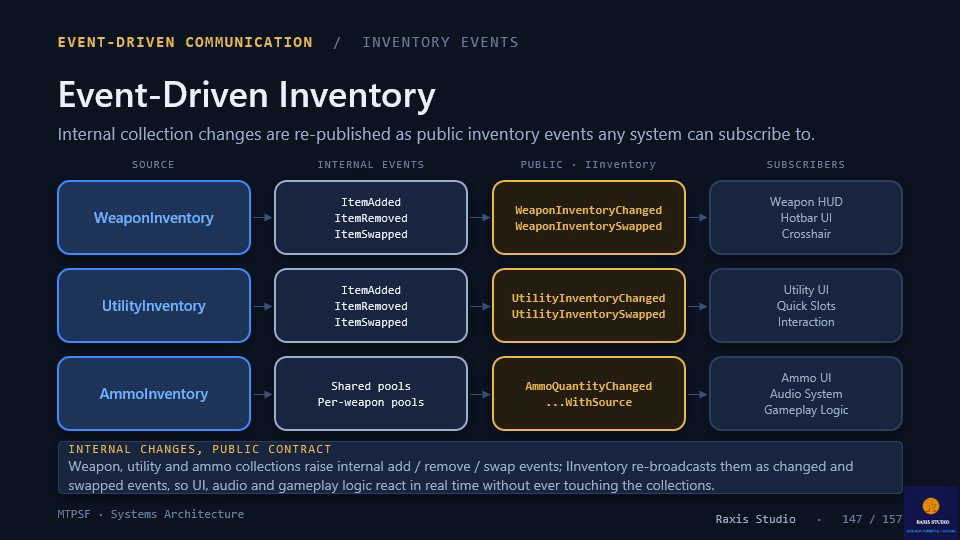
How Event-Driven Design Helps Reduce System Coupling
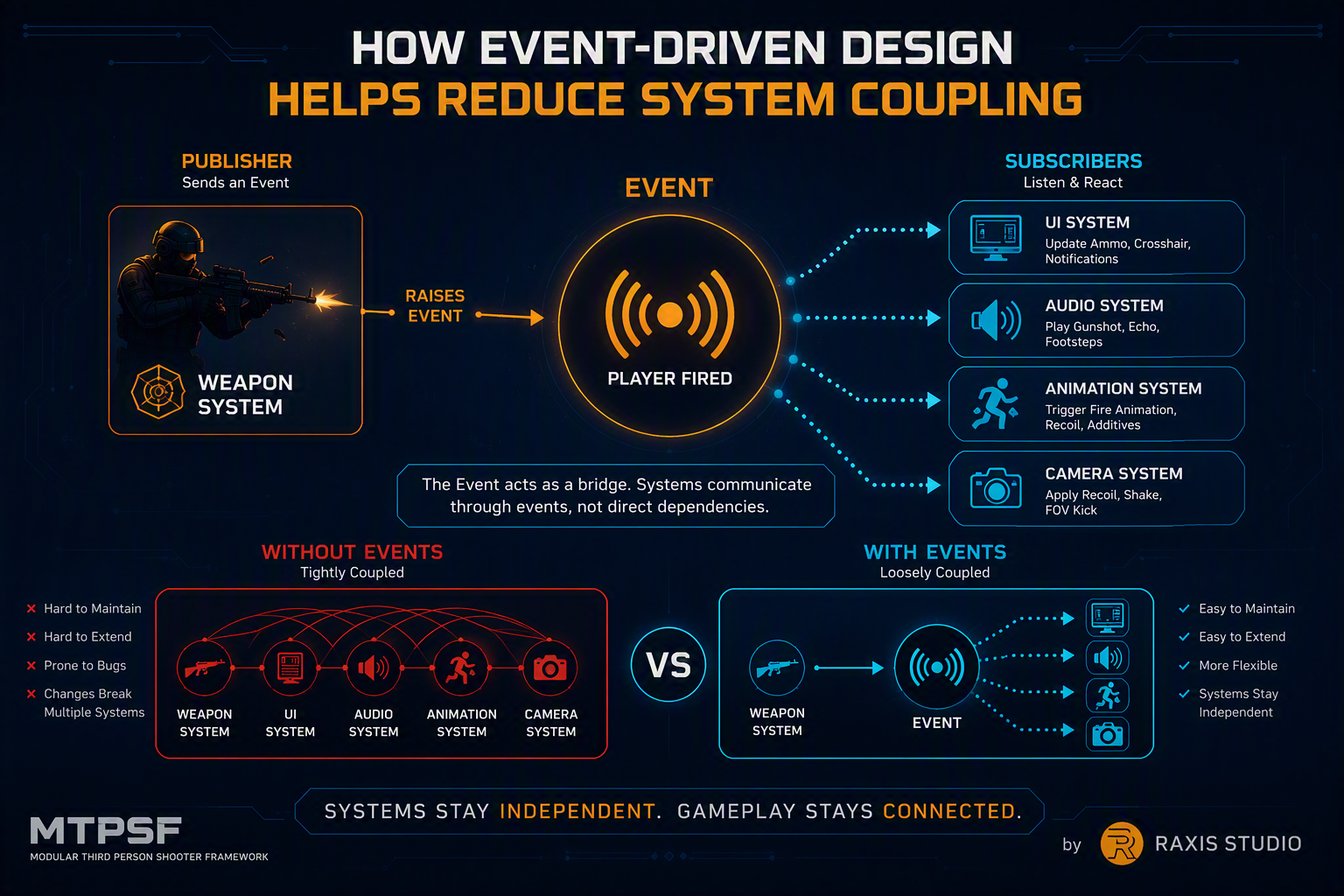
Event-driven design helps reduce system coupling by allowing gameplay systems to respond to changes without needing to control or inspect each other directly.
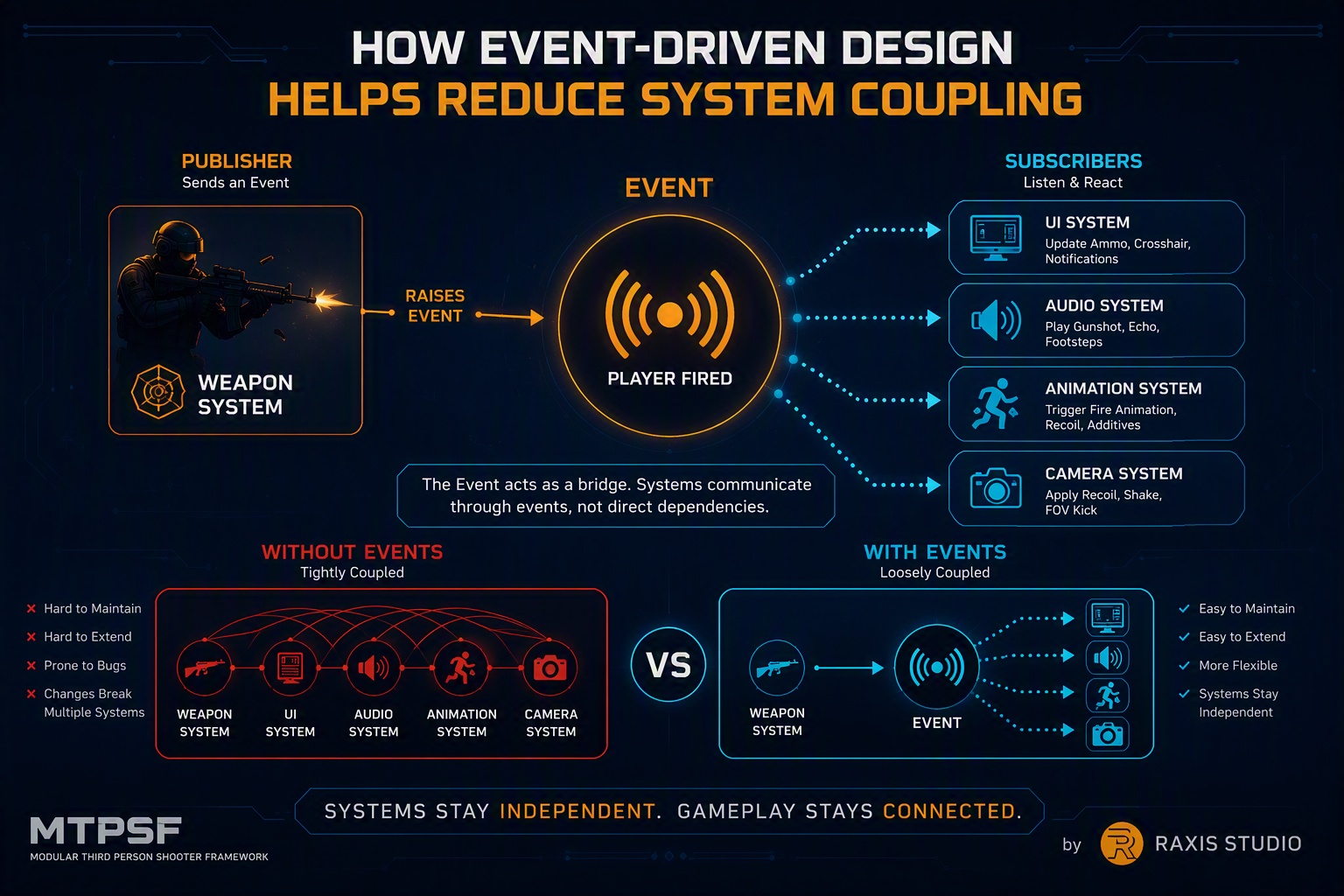
In a modular shooter framework, this can make a major difference because many systems need to react to the same gameplay moments. Weapons, movement, camera behavior, UI feedback, inventory, health, and interaction systems may all need to respond when the player performs an action or when the game state changes. Without an event-driven approach, systems often become connected through direct references. A weapon system may directly tell the UI to update ammunition. A player state system may directly tell the camera to change behavior. A health system may directly call several other systems when damage occurs. These direct calls can work, but they also create relationships that become harder to manage as the framework grows.
The main issue with too many direct connections is that each system starts to know too much about the others. When the weapon system is responsible for notifying the UI, camera, audio, animation, and player state systems directly, it becomes harder to change the weapon logic without checking every connected dependency. A small change in one system can create unexpected behavior in another because the communication path is not clearly separated.
Events provide a cleaner way to handle this communication. Instead of one system controlling several others directly, it can announce that something meaningful happened. Other systems can listen for that event and respond only if the event matters to them.
This allows the source system to stay focused on its own responsibility while the listening systems handle their own reactions.
For example, when ammunition changes, the weapon system does not need to know every detail about how the UI displays that value. It can raise an ammunition changed event. The UI can listen and update itself. Audio or visual feedback systems can listen if needed. Other systems can ignore the event completely. This keeps the weapon system focused on weapon behavior instead of forcing it to manage presentation or feedback details. The same idea applies to many shooter framework situations. A player enters an aiming state. A weapon is equipped. A reload starts or finishes. Health is reduced. An interaction becomes available. A pickup is collected. A surface impact is detected. Each of these moments may be important to more than one system, but the system that detects the moment should not necessarily become responsible for controlling every response.
Event-driven design also supports better extensibility. If a new feature needs to respond to an existing gameplay moment, it can subscribe to the relevant event instead of requiring changes inside the original system. This helps reduce the risk of modifying stable code only to support an additional reaction.
The framework becomes easier to extend because new behavior can be added around existing signals. This does not mean events should be used everywhere without structure. Too many events, poorly named events, or unclear event ownership can create confusion.
Event-driven communication works best when events represent meaningful gameplay changes and when responsibility remains clear. A system should raise events that belong to its role, and other systems should react in ways that fit their own responsibilities.
In MTPSF, event-driven design is part of the broader effort to keep systems modular and easier to reason about. Shooter gameplay requires many systems to feel connected during play, but the internal architecture should avoid unnecessary coupling.
Events, delegates, and actions help create communication points that allow systems to stay aware of important changes without becoming tightly dependent on one another. For developers working with reusable Unity frameworks, this can improve both understanding and adaptation. Clear event names can show what moments exist inside the framework.
A developer can identify where important changes are announced and where different systems respond. This makes the framework easier to study, debug, and extend without tracing a long chain of direct method calls across many components.
Event-driven design reduces coupling because it changes the relationship between systems. Instead of one system owning every reaction, systems can communicate through clear signals. Each system remains responsible for its own behavior, while shared gameplay moments become easier to observe and respond to.
In a modular shooter framework, this helps keep the project more flexible, more readable, and more maintainable as the system grows.