Composition Over Inheritance in MTPSF
Composition over inheritance is an important design direction for modular gameplay frameworks because it helps systems stay flexible as they grow.
In Unity development, inheritance can be useful when objects share a clear and stable relationship, but complex gameplay systems often need behavior that changes, combines, or expands in different ways. A shooter framework is a good example of this challenge.
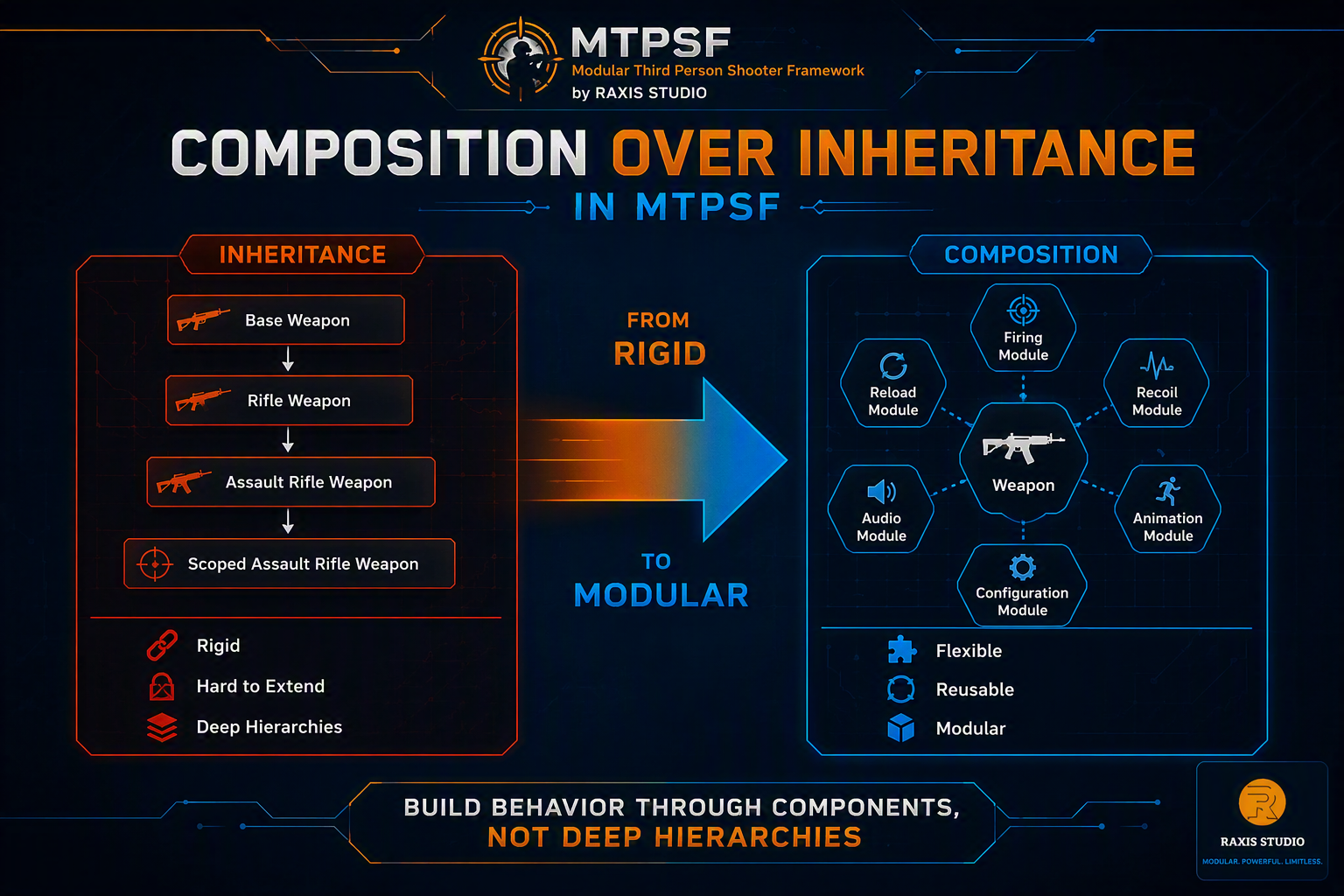
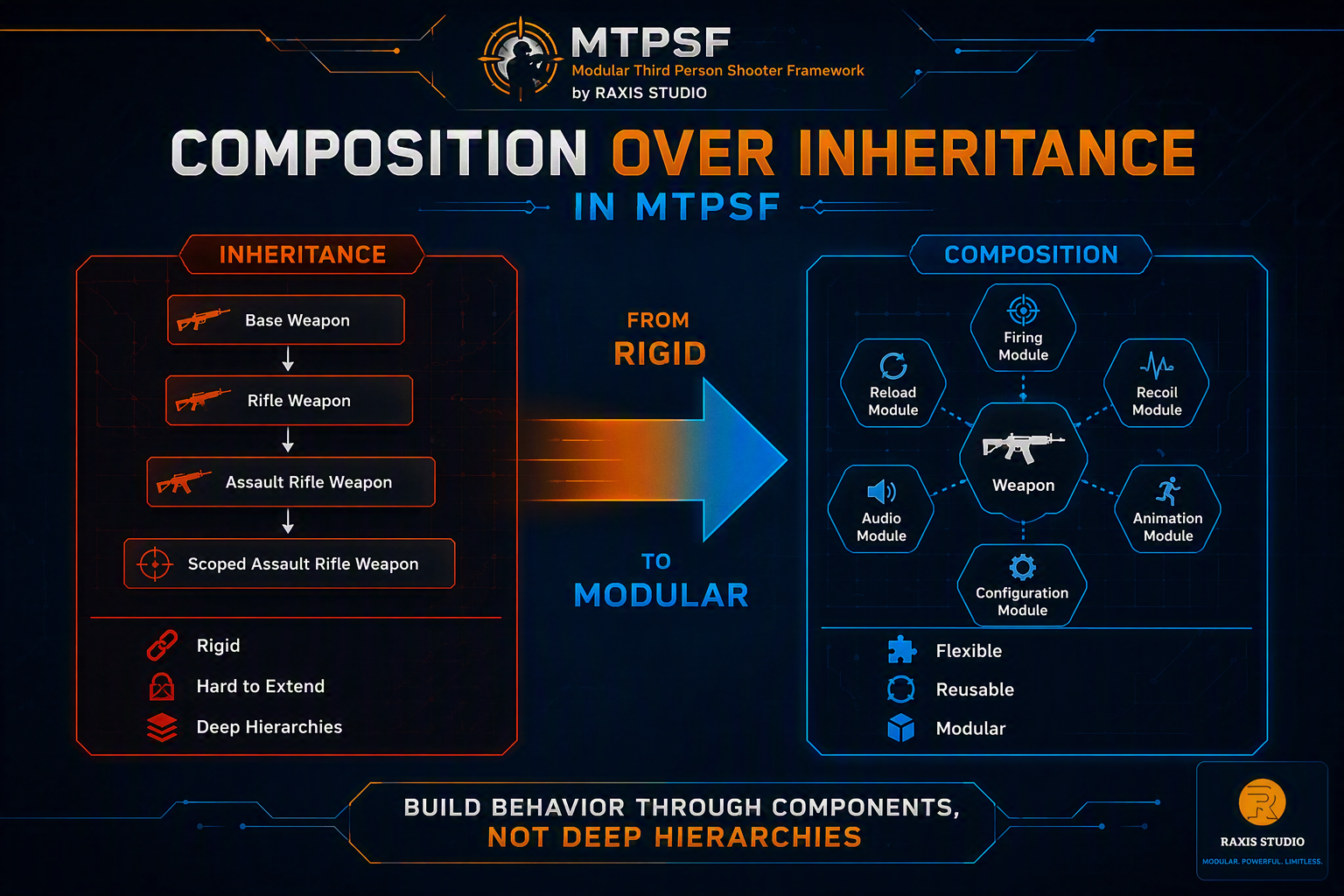
A third person shooter framework may include many kinds of behavior: movement, aiming, shooting, reloading, weapon switching, interaction, health, inventory, camera response, UI feedback, and gameplay state changes. If every variation is handled through deep inheritance chains, the system can become difficult to manage. Each new behavior may require another subclass, another override, or another exception in the hierarchy. This can create a fragile structure over time. A base class may start with a clean purpose, but as more features are added, it may collect logic that does not belong to every child class. Some derived classes may need only part of the behavior, while others need a different variation. When the hierarchy becomes too rigid, changing the base class can affect many systems at once, even when the change was meant for only one behavior.
Composition takes a different approach. Instead of building behavior mainly through inheritance, behavior can be assembled from smaller, focused parts. Each part has a specific responsibility, and the final system gains its behavior from the components or services it uses. This makes it easier to combine features without forcing every object into the same rigid hierarchy.
In a shooter framework, this can be especially useful. A weapon may need firing behavior, reload behavior, spread configuration, recoil response, audio feedback, visual feedback, ammunition logic, and interaction with player state. These behaviors do not always need to come from one long inheritance chain. They can be organized as separate responsibilities that work together through clear structure.
Composition also supports better flexibility when systems need to change. If a new weapon type requires different behavior, the framework does not always need a new branch in a class hierarchy. Instead, the system can use different configured parts, different services, or different behavior modules. This makes it easier to support variation without making the architecture harder to follow.
This approach also helps keep responsibilities clearer. A movement system should not become responsible for every combat condition. A weapon system should not own unrelated player logic. A camera system should not become tightly tied to every weapon implementation. When behavior is composed from focused parts, each part can remain easier to understand, test, and adjust. Composition does not mean inheritance has no place. Inheritance can still be useful for shared base behavior, common abstractions, or cases where a clear parent-child relationship exists.
The important point is to avoid forcing every feature into inheritance when the behavior would be easier to manage as a composed part of the system.
MTPSF is being shaped with this balance in mind. A modular shooter framework needs systems that can cooperate without becoming locked into one rigid structure.
Composition helps support that direction because it allows the framework to build behavior through connected pieces instead of relying only on deep class relationships.
For developers using reusable Unity assets, this can make a noticeable difference. A framework that relies too heavily on inheritance may be difficult to adapt when project requirements do not match the original hierarchy. A framework that uses composition thoughtfully can provide more room for extension because behavior is not trapped inside a single inheritance path. Composition over inheritance matters because shooter systems are rarely static. New weapon types, new interactions, new camera behaviors, new UI responses, and new gameplay conditions can appear as a project evolves.
A modular framework should be able to support that growth without becoming harder to maintain with every added feature. By using composition as a guiding principle, MTPSF can keep its systems more flexible, readable, and practical for long-term development.
The goal is not to avoid inheritance completely, but to use the right structure for the right responsibility. In a modular shooter framework, that balance helps create systems that are easier to understand, easier to configure, and easier to build upon.